Why the old town is red
The Stadthuys, Christ Church and the clock tower are the colour on every postcard of Melaka. For most of their history, they were white.
2 min read
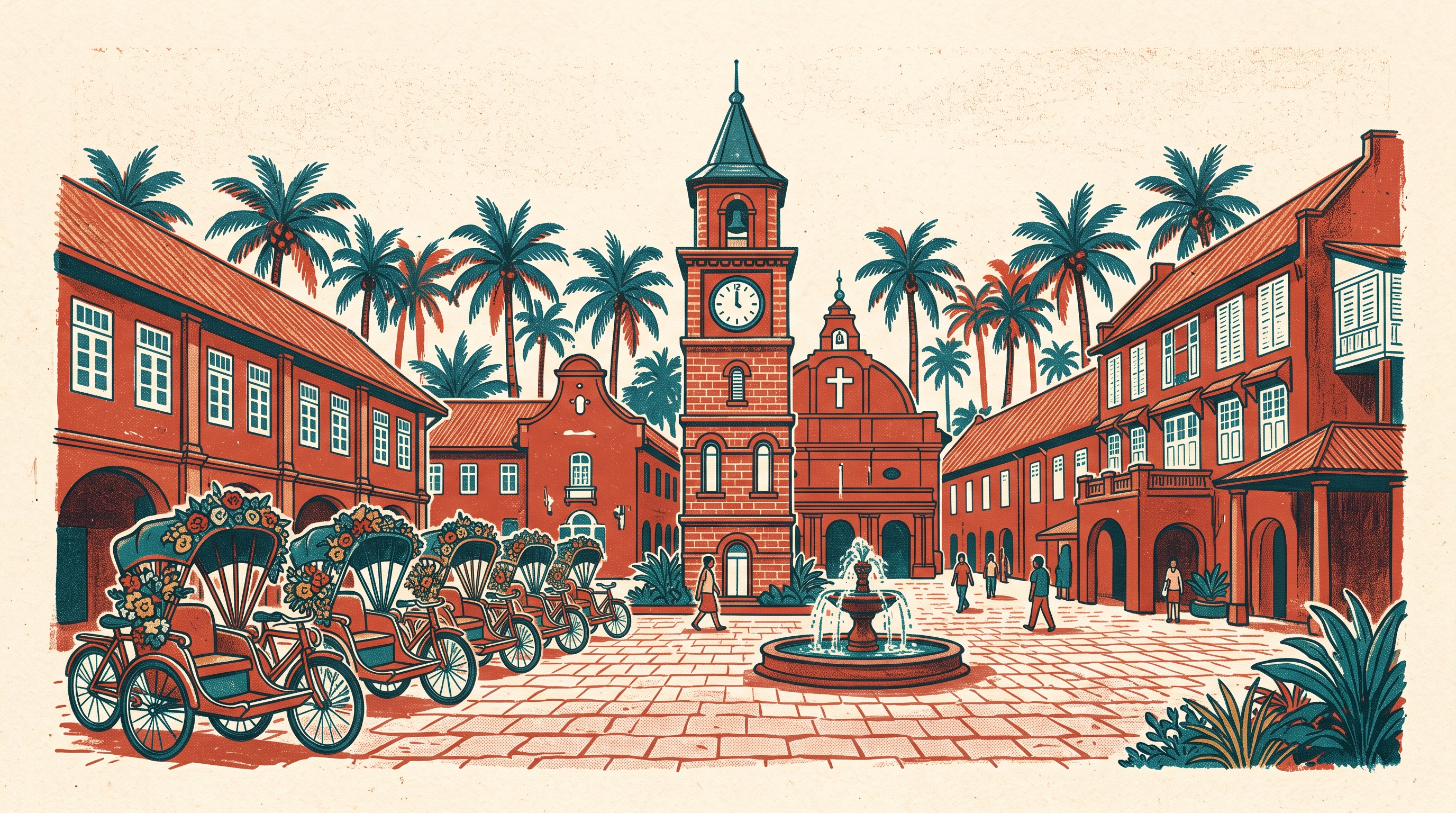
The centre of old Melaka is a small square that almost everyone calls the Red Square. On one side stands the Stadthuys, the old Dutch town hall. Beside it is Christ Church, plain, solid and unmistakably Dutch. In the middle are a clock tower and a fountain, and along the edge the trishaws wait in a bright, noisy line. Nearly everything is painted the same deep terracotta, and that colour is now on every postcard of the city.
The Dutch town
The Dutch East India Company took Melaka from the Portuguese in 1641 and held it, with one long interruption, for most of the next two centuries. The Stadthuys was among the first things it built, in the decades after the conquest, as the seat of the governor and his officials. It is usually described as the oldest surviving Dutch building in Asia: thick walls, heavy timber doors, wrought iron fittings, the design of a Dutch town hall adapted to a place with no winter.
Christ Church came a century later. It was begun in 1741 and finished in 1753, to mark a hundred years of Dutch rule, and it is still a working Anglican church. The great ceiling beams are said to have been cut from single trees, without joins. On Sunday mornings the square fills with people who have come for the service rather than the photographs.
Then came the paint
For most of their lives these buildings were white. The British, who took over Melaka for good under the Anglo-Dutch Treaty of 1824, inherited them that way and kept them that way for a long time.
The red arrived later, most accounts say in the early twentieth century, and nobody is entirely sure why. The most popular explanation is a practical one. The tropical rain kept splashing the local red laterite earth onto the white walls, and at some point the authorities stopped fighting it and painted everything to match. It may simply be a good story. Either way, the paint stuck, and a colour that may have begun as a maintenance decision became the identity of a city.
A square full of time
Everything else in the square came later still. The clock tower was put up in 1886 by Tan Jiak Kim, from a wealthy Straits Chinese family, in memory of his father, Tan Beng Swee. The fountain was built at the start of the twentieth century to commemorate Queen Victoria. The British used the Stadthuys as government offices, and today it houses the city’s museum of history and ethnography.
A short walk away, on a field near the old seafront, Tunku Abdul Rahman, soon to be Malaya’s first prime minister, stood in front of an enormous crowd on 20 February 1956 and announced the date on which the country would become independent. The British stayed in Melaka for well over a century. The paint they left behind has now outlasted them by nearly seventy years, long enough that nobody here thinks of it as British at all.
Filed under the past tense
