One gate, two empires
Of the great Portuguese fortress of A Famosa, only one gate survives. It carries a Dutch coat of arms, and it may owe its survival to an Englishman.
3 min read
In July 1511 a Portuguese fleet under Afonso de Albuquerque anchored off Melaka. Albuquerque had taken Goa the year before, and he understood what Tomé Pires would later put into words: whoever held the port that controlled the strait held the spice trade. After weeks of negotiation and two assaults on the bridge across the river, the city fell in August. Sultan Mahmud Shah fled, and his heirs went on to found the sultanates of Johor and Perak.
Albuquerque wanted the conquest to last, so he built. On the hill beside the river mouth rose a fortress the Portuguese called A Famosa, the Famous One. Its walls looped around the foot of the hill and down to the sea, and much of the stone, the chroniclers admit, was taken from the city’s mosques and royal tombs. For the next 130 years it was one of the strongest European forts in Asia, and it was besieged again and again: by the dispossessed sultans, by Aceh, by Johor, and finally by the Dutch.
The gate
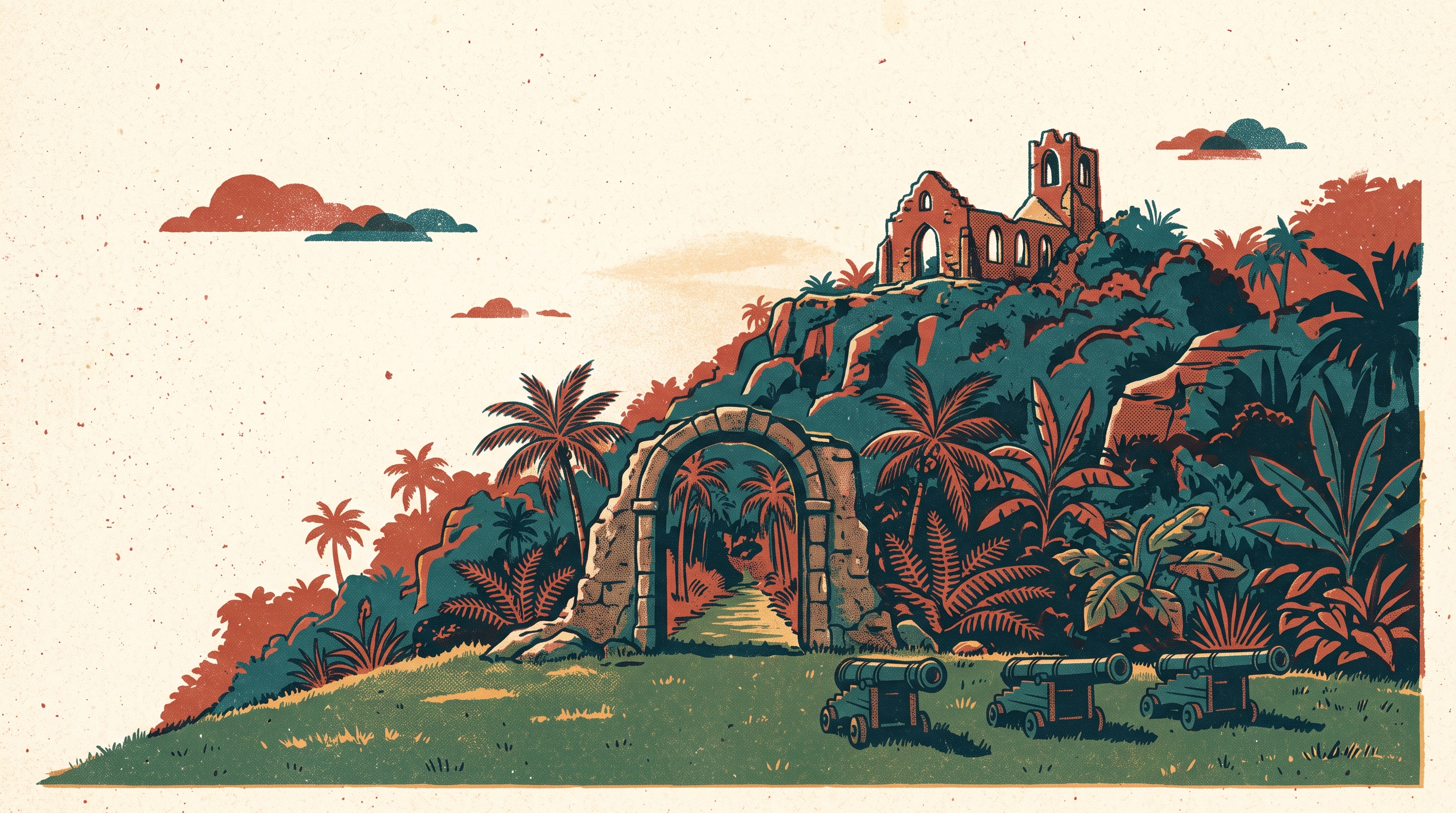
What you can see today is a single gateway, the Porta de Santiago, standing on a patch of lawn at the foot of the hill with a few old cannon arranged in front of it for photographs. Look closely at the top of the arch. The coat of arms carved there is not Portuguese. It belongs to the Dutch East India Company, and below it is the date 1670.
The Dutch took Melaka in January 1641, after a siege of more than five months fought alongside their allies from Johor, and the fortress was badly damaged in the process. They repaired it rather than replace it, and when they rebuilt this gate they added their own emblem. So the most famous Portuguese monument in Malaysia is, at least where the inscription is concerned, a Dutch one.
Saved by a visitor
The fortress outlasted the Portuguese and the Dutch, but not the British. During the Napoleonic Wars Britain held Melaka on behalf of the Dutch, and around 1807 it began demolishing the walls so that the fort would be of no use to whoever held the city next. Gunpowder took most of it. The gate was spared, and the credit usually goes to Stamford Raffles, then a young official in Penang, who visited Melaka and argued against destroying what remained. Whether one man’s protest really made the difference is hard to prove. The gate is still there either way.
The church on the hill
Climb the steps behind the gate and you reach the roofless shell of St Paul’s Church. It began in 1521 as a small chapel built by a Portuguese captain, Duarte Coelho, in thanks for surviving a storm at sea, and it was later handed to the Jesuits. Francis Xavier preached here, and when he died off the coast of China in 1552 his body was brought back and buried in the church for several months before being taken on to Goa. His empty grave is still there, behind a wire grille.
After the Dutch finished their own church in the town below, St Paul’s became a burial ground, and its walls are now lined with tall tombstones, their inscriptions worn soft by centuries of rain. From the top of the hill you can see the whole story at once: the river the sultans traded on, the last stones of a Portuguese fortress, a gate with a Dutch crest, and beyond them, new land and new towers where the sea used to be.
Filed under the past tense
